

When Bong Joon-ho walked onto the Oscars stage in 2020 to accept Best Picture for Parasite, he didn’t just make history-he shattered a ceiling that had stood for nearly a century. No foreign-language film had ever won the top prize. But Bong didn’t arrive there by accident. His rise was built on decades of bold storytelling, genre-bending visuals, and a deep understanding of class, power, and human absurdity. He didn’t just make movies. He built worlds that reflect Korea’s soul-and the world’s.
From Underground Films to Global Dominance
Bong Joon-ho didn’t start in the spotlight. He began in the 1990s, making short films and working in Korea’s indie scene, where budgets were tight and audiences were small. His first feature, Barking Dogs Never Bite (2000), was a dark comedy about a man obsessed with a neighbor’s dog. It didn’t make waves internationally, but it showed his signature style: mixing humor with horror, the mundane with the monstrous.
By 2003, he released Memories of Murder, a chilling true-crime drama based on Korea’s first known serial killer. The film wasn’t just a thriller-it was a meditation on institutional failure, corruption, and the slow erosion of hope. Critics called it the best Korean film ever made. It still is.
What set Bong apart wasn’t just his skill. It was his refusal to stay in one lane. He didn’t make ‘Korean films.’ He made films that used Korea as a lens to examine universal truths. He blended horror, satire, sci-fi, and drama like a chef mixing spices-each flavor sharp, distinct, but never overwhelming.
The Class War in Three Acts
Parasite (2019) is often called a thriller. It’s not. It’s a class allegory wrapped in a dark comedy, then exploded into a tragedy. The Kim family, living in a semi-basement, infiltrates the wealthy Park household by posing as servants. The tension builds slowly, like water rising in a flooded basement. Then-boom.
The famous rain scene isn’t just cinematic. It’s symbolic. The Parks’ home stays dry. The Kims’ home floods. The rich stay clean. The poor drown. Bong doesn’t need dialogue to say this. He shows it in the way the Kims scramble up the stairs, covered in mud, while the Parks complain about the smell of ‘old people’ on the sofa.
He doesn’t paint the Parks as evil. They’re clueless. That’s worse. They’re not villains-they’re beneficiaries of a system they don’t even see. The Kims aren’t saints. They lie, cheat, and steal. But you understand why. Bong doesn’t ask you to choose sides. He asks you to look at the whole house.
Science Fiction as Social Commentary
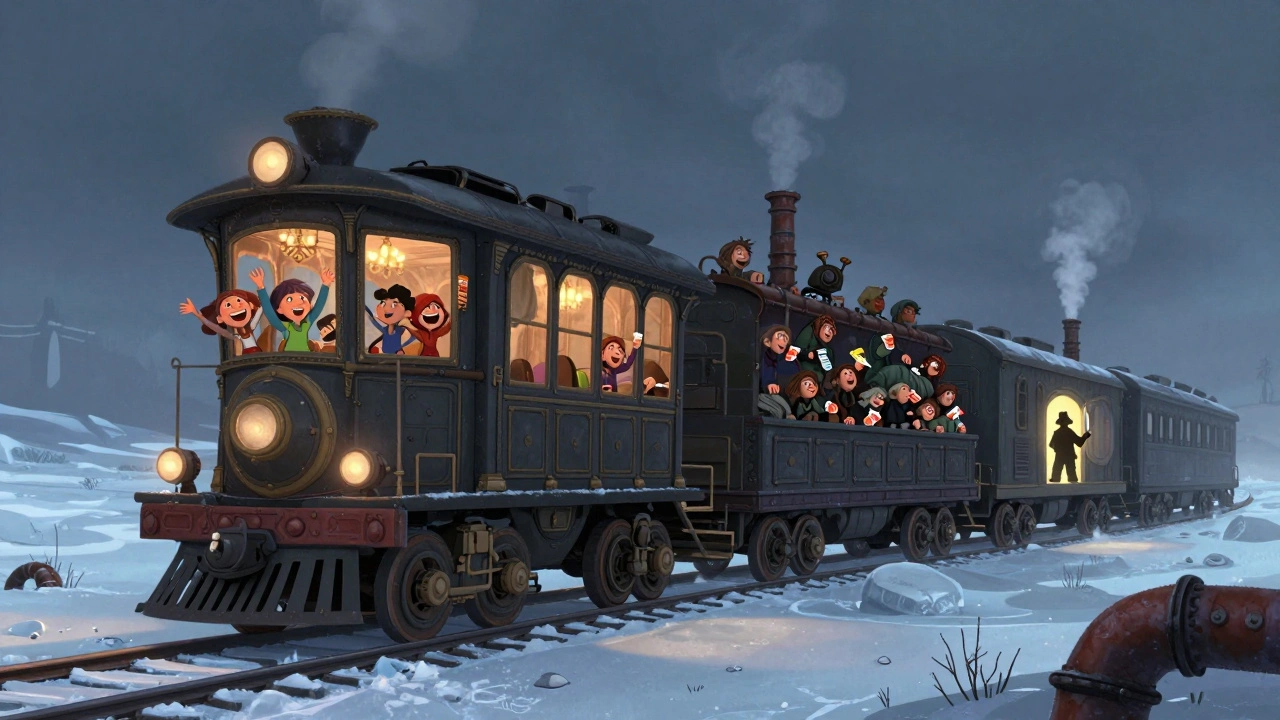
Before Parasite, Bong made Snowpiercer (2013), a dystopian train where the rich live in luxury at the front and the poor are crammed in the tail, eating protein bars made from bugs. The train circles a frozen Earth. No one escapes. No one fixes it.
The film’s central metaphor is obvious-but Bong makes it feel real. The tail section is filthy, starving, and violent. The front is full of art classes, swimming pools, and children laughing. The rebellion isn’t about overthrowing the system. It’s about realizing the system was never meant to be fixed. It was meant to be ridden.
He didn’t use CGI to build the train. He built a real 100-meter-long set. Actors lived on it for months. The claustrophobia? Real. The hunger? Real. The rage? Real.
That’s Bong’s trick. He doesn’t make allegories. He makes realities that just happen to be exaggerated.
Animals, Corporations, and the Price of Progress
In Okja (2017), Bong turns the animal rights debate inside out. A Korean girl, Mija, fights to save her genetically engineered super-pig from a global agribusiness giant. The company, Mirando, markets Okja as a solution to world hunger. But behind the PR campaign? Slaughterhouses, lab tests, and corporate lies.
The film doesn’t pick sides. It doesn’t say ‘vegan good, meat bad.’ It says: ‘Who benefits from your compassion?’ The activists who rescue Okja are just as manipulative as the corporation. They use Mija’s grief to sell a movement. Bong shows how even good causes get co-opted by capitalism.
Okja herself is the only pure character. She doesn’t speak. She doesn’t judge. She just exists. And that’s the point. In a world of noise, the quietest voice is the most honest.
Why Bong Joon-ho Works Everywhere
Western audiences didn’t connect with Korean cinema until Bong came along. Why? Because he didn’t try to make Korean films ‘accessible.’ He made them human.
He doesn’t explain cultural details. He doesn’t translate emotions. You see a character cry, and you know why. You see a family eat kimchi, and you understand their bond. You don’t need to know what kimchi is to feel the love in that meal.
His films have no ‘foreign’ feel. They feel universal because they’re rooted in real things: hunger, fear, love, betrayal. He uses genre as a tool, not a cage. Parasite is a thriller. Snowpiercer is sci-fi. Okja is a family drama. But they’re all about the same thing: how power distorts humanity.
He also works with the same team-cinematographer Hong Kyung-pyo, composer Jung Jae-il, editor Yang Jin-mo. That consistency matters. It’s like a jazz band that’s played together for 20 years. They don’t need to talk. They just know.

The Korean Wave Isn’t Just K-Pop
When people think of the Korean Wave, they think of BTS or Squid Game. But Bong Joon-ho was the first to break through the global glass ceiling. He didn’t wait for permission. He made films that were too good to ignore.
Before him, Korean cinema was seen as niche. After him? It’s essential. Directors like Lee Chang-dong and Park Chan-wook got more attention. Netflix and Amazon started investing in Korean stories. Streaming platforms now compete for Korean content. Why? Because Bong proved it could win Oscars, not just awards at Busan.
He didn’t change Korean cinema. He revealed what was already there: a culture that doesn’t flinch from darkness, that laughs in the face of despair, and that never lets the powerful off the hook.
What Comes Next?
Bong’s next project, Yokai, is rumored to be a supernatural thriller based on Korean folklore. No official details yet. But if history holds, it won’t be about ghosts. It’ll be about greed. About silence. About who gets to tell the story.
He’s not chasing trends. He’s not making sequels. He’s not signing deals with studios for franchises. He makes films because he has something to say-and he knows how to say it in a way that sticks.
That’s why he’s not just a director. He’s a mirror. And the world is finally looking into it.
Is Bong Joon-ho the most important filmmaker of the 21st century?
He’s among the most influential. No other director since 2000 has won the Oscar for Best Picture with a non-English film. He’s also the only filmmaker to win Best Picture, Best Director, Best Original Screenplay, and Best International Feature for the same movie. His work has reshaped how global audiences view non-Western cinema-not as exotic, but as essential.
What makes Bong Joon-ho’s films different from other Korean directors?
Other Korean directors like Park Chan-wook focus on revenge and moral ambiguity. Lee Chang-dong explores quiet despair. Bong blends genres and tones in ways no one else does. He can make you laugh at a character’s stupidity, then gasp at their cruelty-all in one scene. He also has a unique visual rhythm: long takes, deliberate pacing, and sudden bursts of violence that feel earned, not cheap.
Do I need to understand Korean culture to enjoy Bong Joon-ho’s films?
No. His films work because they tap into universal emotions-fear, hunger, family loyalty, injustice. You don’t need to know what a jjigae stew is to feel the desperation of a family eating it. You don’t need to know Korean class structures to understand the pain of being invisible. Bong makes the specific feel global.
Which Bong Joon-ho film should I watch first?
Start with Parasite. It’s his most accessible, most awarded, and most complete work. If you like it, go back to Memories of Murder for his gritty realism, then watch Snowpiercer for his sci-fi edge. Okja is the emotional core of his filmography-don’t skip it.
Has Bong Joon-ho influenced other filmmakers?
Yes. Directors like Jordan Peele, Greta Gerwig, and Denis Villeneuve have cited him as an influence. Peele’s Get Out shares Parasite’s structure: a family hiding in plain sight, masked by politeness. Villeneuve’s Dune echoes Snowpiercer’s class-based hierarchy. Bong didn’t just make great films-he showed how genre can be a vehicle for deep social critique.