

Moonlight doesn’t feel like a movie you watch. It feels like a memory you didn’t know you had. Released in 2016, Barry Jenkins’ third feature film is a quiet, devastating portrait of a Black gay man growing up in Miami’s drug-ravaged neighborhoods. There are no grand speeches, no heroic arcs, no dramatic showdowns. Instead, there are glances. Hands that almost touch. Silence that speaks louder than any line of dialogue. And three chapters that trace a boy named Chiron from childhood to adulthood, each one a brushstroke in a portrait of identity shaped by pain, love, and survival.
Three Lives, One Soul
The second act, set in high school, is where the cracks widen. Chiron, now played by Ashton Sanders, is more withdrawn, more isolated. His only friend, Kevin, is the one person who sees him. Their moment together on the beach-soft, hesitant, real-is one of the most tender scenes in modern cinema. But when Kevin betrays him under pressure, Chiron’s silence turns inward. He learns to protect himself by becoming someone else.
The third act, set a decade later, shows Chiron as a hardened man named Black, played by Trevante Rhodes. He’s muscular, wears gold teeth, drives a luxury car, and sells drugs like Juan once did. But his posture is rigid. His eyes never relax. When Kevin calls him out of the blue, the reunion is raw, awkward, and achingly human. Over a plate of diner food, Chiron finally lets his guard down. He admits he never stopped loving Kevin. And for the first time, we see him cry.
The Language of Silence
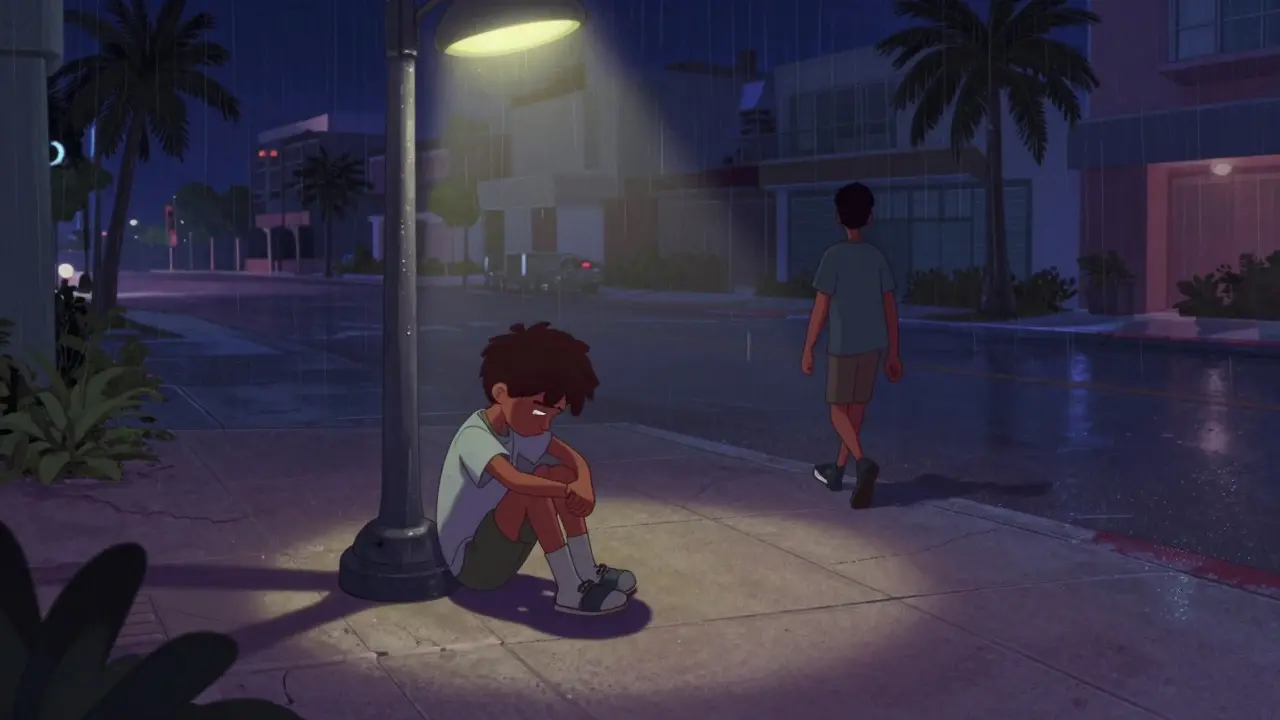
Jenkins doesn’t rely on exposition. He doesn’t explain Chiron’s sexuality. He doesn’t justify his mother’s addiction. He doesn’t moralize about the drug trade. Instead, he lets the camera linger. A hand brushing a shoulder. A reflection in a puddle. The way Chiron’s body tenses when someone calls him a name. The score by Nicholas Britell-a haunting blend of piano and strings-doesn’t underscore the emotion. It becomes the emotion.There’s a scene where Chiron, as a teenager, walks home alone after being beaten. The camera follows him from behind, the streetlights flickering. No music. No dialogue. Just his footsteps and the hum of the city. You don’t need to know what he’s thinking. You feel it in your chest. That’s the power of this film: it trusts the audience to sit with discomfort, to feel without being told how to feel.
Identity as a Reflection
Chiron’s identity isn’t something he discovers. It’s something he’s forced to hide, then reshape, then bury. In a world that tells him he’s too soft, too Black, too gay to survive, he learns to armor himself. But the film doesn’t frame his transformation as a betrayal. It frames it as adaptation. His silence isn’t weakness-it’s survival. His strength isn’t in being loud-it’s in still being alive.Jenkins, who grew up in Liberty City, Miami, drew from his own experiences. He didn’t set out to make a political film. He set out to make a film about a boy who looked like him, loved like him, and felt like him. That’s why Moonlight resonates beyond LGBTQ+ or Black cinema. It’s about anyone who’s ever felt invisible. Anyone who’s ever had to shrink themselves to fit in. Anyone who’s loved someone they couldn’t say their name to.
Performance as Revelation
The casting is flawless. Alex Hibbert, Ashton Sanders, and Trevante Rhodes don’t just play Chiron-they become him. Their physicality, their silence, their gaze-all of it connects. You don’t see three actors. You see one soul unfolding over time.Naomie Harris as Paula is devastating. She doesn’t play a drug addict. She plays a woman drowning in guilt, trying to love her son through a haze of addiction. Her breakdown in the motel room, screaming at Chiron while reaching for him, is one of the most raw performances in recent memory.
Mahershala Ali as Juan won the Oscar for Best Supporting Actor. But his performance isn’t about winning awards. It’s about presence. He doesn’t fix Chiron’s world. He just shows up. And sometimes, that’s enough.

Why It Still Matters
In 2025, with streaming platforms drowning in noise and spectacle, Moonlight feels more necessary than ever. It doesn’t offer easy answers. It doesn’t make you feel good. But it makes you feel seen.It’s not a film about coming out. It’s a film about staying in. About carrying your truth when the world refuses to hold it. About finding love in the spaces between words. About the quiet courage it takes to be yourself when being yourself could cost you everything.
Barry Jenkins didn’t make a movie about identity. He made a mirror. And if you’ve ever felt like you didn’t belong, you’ll recognize yourself in it.
Is Moonlight based on a true story?
No, Moonlight isn’t based on a true story, but it’s deeply personal. Writer Tarell Alvin McCraney wrote the play In Moonlight Black Boys Look Blue, which drew from his own childhood growing up in Liberty City, Miami. Barry Jenkins adapted it, weaving in his own experiences. The emotions, the neighborhoods, the silence-all of it comes from real life.
Why did Moonlight win Best Picture at the Oscars?
Moonlight won Best Picture because it broke every rule of what a "Oscar-worthy" film was supposed to be. It had a small budget, no big stars, minimal dialogue, and centered on a queer Black protagonist at a time when Hollywood rarely did. But it moved people-not with spectacle, but with truth. The Academy recognized that it wasn’t just a good film. It was a necessary one.
Is Moonlight a gay love story?
It’s more than that. Yes, Chiron’s love for Kevin is central, but the film isn’t about romance. It’s about how love shapes identity when society tells you that love is wrong. The relationship between Chiron and Kevin isn’t idealized-it’s messy, fleeting, and real. That’s what makes it powerful.
What makes Barry Jenkins’ direction unique?
Jenkins uses long takes, natural lighting, and intimate framing to make the viewer feel like they’re inside Chiron’s skin. He avoids close-ups unless they’re necessary. He lets silence breathe. His camera doesn’t judge-it observes. That restraint is what makes his films feel like poetry.
Where can I watch Moonlight today?
Moonlight is available on streaming platforms like Apple TV+, Amazon Prime Video, and Google Play Movies. It’s also available for digital rental or purchase on most major services. Check your local platform, as availability can vary by region.
What to Watch Next
If Moonlight left you quiet and thoughtful, try these films that share its emotional honesty:- Call Me by Your Name - A tender coming-of-age romance with similar attention to silence and longing.
- The Florida Project - A raw look at childhood in poverty, directed by Sean Baker.
- Pariah - A 2011 indie film about a Black lesbian teenager finding herself in Brooklyn.
- Portrait of a Lady on Fire - A visually stunning, emotionally restrained love story set in 18th-century France.
- Minari - A quiet family drama about immigration, identity, and belonging in rural America.
These films don’t shout. They whisper. And sometimes, that’s how the deepest truths get heard.