
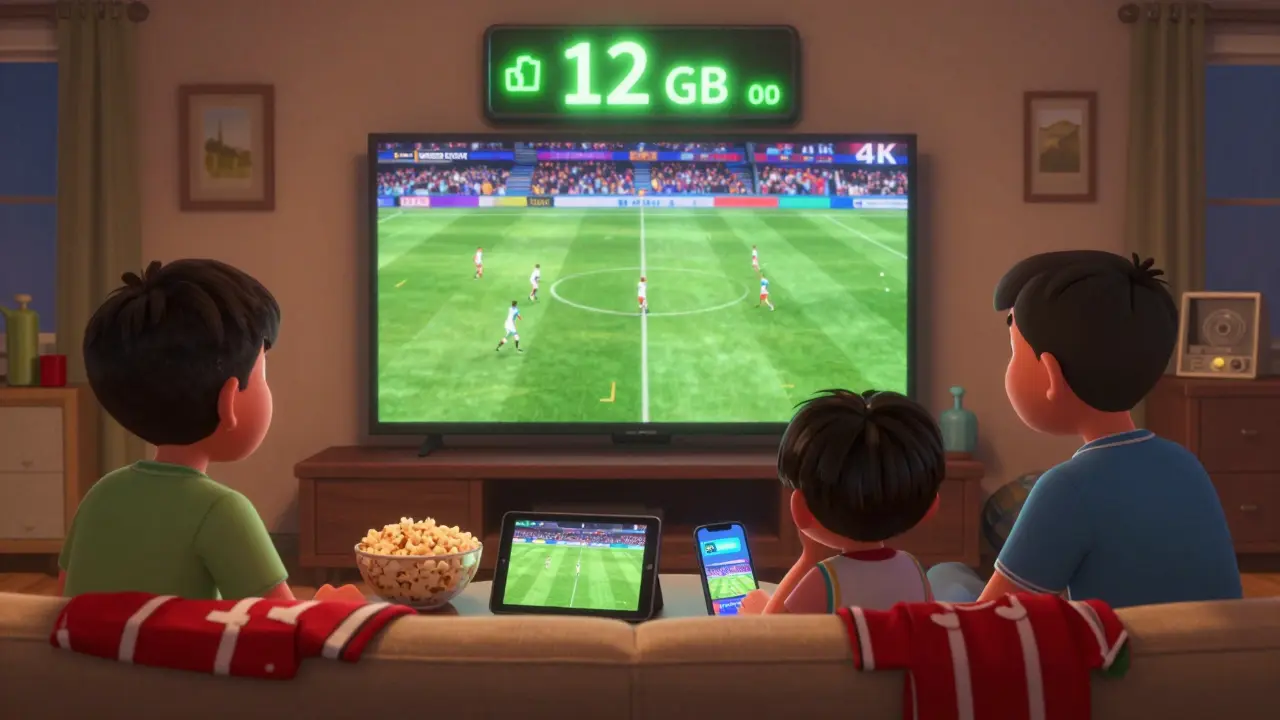
Ever sat down to watch a big game, only to have it buffer halfway through? Or worse - paid for a premium sports package, only to realize your internet can’t handle it? You’re not alone. Millions of people stream sports every week, but few actually know how much data it eats up. The truth is, not all sports streams are created equal. A 720p soccer match uses way less than a 4K NFL game with Dolby Atmos sound. And if you’re on a capped plan, running out of data mid-playoff season can cost you more than just frustration.
How much data does sports streaming actually use?
It all comes down to resolution and compression. Most sports streaming services - like ESPN+, DAZN, FuboTV, or your cable provider’s app - offer multiple quality settings. Here’s what you’re really using:
- Standard Definition (SD) - 480p: around 0.7 GB per hour
- High Definition (HD) - 720p or 1080p: 1.5 to 3 GB per hour
- Full HD (1080p) with higher bitrate: up to 4 GB per hour
- 4K Ultra HD: 7 to 15 GB per hour
That’s not just numbers. If you watch three 2-hour Premier League matches a week in 4K, you’re burning through over 60 GB in a month. That’s more than half the data allowance on many mobile plans. And if you’re streaming on multiple devices - say, your TV, tablet, and phone - the numbers stack fast.
Why do some sports use more data than others?
Not all sports are streamed the same way. Fast-paced sports like hockey, basketball, or Formula 1 need higher frame rates to keep up with the action. That means more data. A 60fps NBA game uses up to 40% more bandwidth than a 30fps baseball game, even at the same resolution.
Also, some networks use advanced compression like H.265 (HEVC) to save space. Others stick with older H.264, which is less efficient. You might not see the difference on screen, but your data meter will. For example, a 1080p NFL game on ESPN+ might hit 3.8 GB/hour, while the same game on YouTube TV could be closer to 4.5 GB/hour - same resolution, different tech.
Then there’s audio. Dolby Atmos or 5.1 surround sound adds another 100-200 MB per hour. It’s not much on its own, but when you’re watching 15 hours of sports a month, that’s an extra 2-3 GB. And if you’re watching on a smart TV with voice control turned on, background processes can eat another 50 MB/hour just keeping the system awake.
What internet speed do you really need?
Bandwidth and data aren’t the same thing. Bandwidth is how fast the data flows. Data is how much you use. You can have a 100 Mbps connection but still run out of data if you stream 4K all day.
Here’s what you need for smooth streaming:
- SD (480p): 3 Mbps minimum
- HD (720p/1080p): 5-8 Mbps recommended
- 4K (Ultra HD): 25 Mbps minimum, 40 Mbps ideal
These are the minimums. Real-world performance? Add 20-30% extra. Why? Because networks aren’t perfect. Wi-Fi interference, multiple users, background updates - they all slow things down. If you’re streaming on a 100 Mbps plan but have five people in the house using the internet, your actual speed during a game might drop to 30 Mbps. That’s fine for 4K if you’re the only one watching, but if someone else is downloading a game or video calling, you’ll start buffering.
Pro tip: Run a speed test during your usual game time. Not at 2 a.m. when no one’s online. Test it at 8 p.m. on a Saturday. That’s when your real-world speed matters.

How to cut data usage without losing quality
You don’t have to sacrifice the experience to save data. Here’s how real people do it:
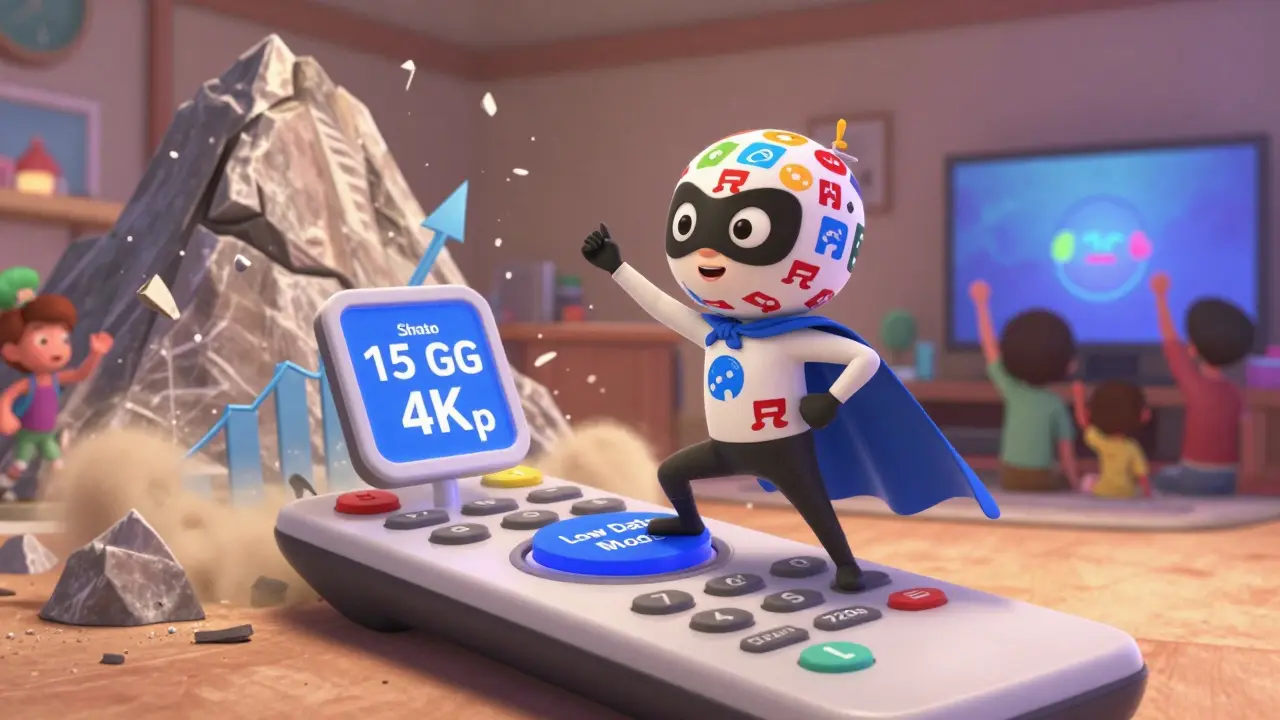
- Use the app’s data saver mode. Most services - including NFL Sunday Ticket and DAZN - have a “Low Data” or “Data Saver” setting. It drops resolution to 720p automatically. You still get crisp, smooth video, but you save 50-70% of your data.
- Download games to watch later. If your provider lets you download (like ESPN+ or FuboTV on mobile), do it while on Wi-Fi. Then watch offline. No streaming = zero data usage.
- Turn off autoplay. After the final whistle, most apps automatically start the next game or highlight reel. That’s extra data you didn’t ask for. Disable it in settings.
- Use Ethernet over Wi-Fi. If you’re streaming to your TV, plug it in. Wi-Fi is convenient, but it’s leaky. A wired connection reduces buffering, which means less rebuffering = less wasted data.
- Set quality limits in your router. Some advanced routers let you cap bandwidth per device. Set your streaming box to 8 Mbps max - that locks it at HD, even if the app tries to push 4K. Saves data without you thinking about it.
What happens if you go over your data limit?
It depends on your provider. In the U.S., many ISPs throttle your speed after you hit the cap - meaning your 4K stream turns into a pixelated slideshow. In Europe, especially Ireland, most plans are now truly unlimited. But if you’re on a mobile hotspot or a budget plan, you might get charged extra or cut off entirely.
Check your plan. Look for phrases like “unlimited after throttling,” “fair usage policy,” or “data cap.” If your plan says “100 GB monthly,” and you watch 10 hours of 4K sports a week, you’re going over in less than two weeks. That’s not a guess - it’s math.
Best setups for heavy sports viewers
If you’re serious about sports, here’s what works:
- Home setup: Fiber internet (100+ Mbps), wired TV box, 1080p or 4K streaming with data saver enabled.
- Mobile setup: Use Wi-Fi whenever possible. Download games overnight. Avoid streaming on cellular unless you have an unlimited plan.
- Multi-room viewing: If you’ve got TVs in the living room, kitchen, and bedroom, consider a mesh Wi-Fi system. Single routers can’t handle three simultaneous 4K streams without dropping frames.
- Backup plan: Keep a portable hotspot with a large data allowance. If your home internet goes down during playoffs, you can still watch on your tablet.
Real-world example: A month of sports streaming
Let’s say you watch:
- 4 Premier League matches (2 hours each) at 1080p → 4 x 2 x 3 GB = 24 GB
- 2 NBA games (2.5 hours each) at 4K → 2 x 2.5 x 10 GB = 50 GB
- 1 F1 Grand Prix (2 hours) at 4K → 2 x 12 GB = 24 GB
- 5 highlight reels (30 minutes each) at 720p → 5 x 0.5 x 1.5 GB = 3.75 GB
Total: 101.75 GB in one month.
That’s over 3 GB per day. On a 100 GB plan? You’re out by day 30. On a 200 GB plan? You’re fine - but barely. On a 50 GB plan? You’re throttled or charged extra.
Final checklist: Are you ready for sports season?
Before the next big event, ask yourself:
- Do I know my current data limit?
- Have I checked my internet speed during peak hours?
- Am I using data saver mode on my streaming apps?
- Do I have a wired connection for my main TV?
- Have I turned off autoplay and background streaming?
- Do I have a backup plan if my internet fails?
If you answered no to more than two of these, you’re one game away from a buffering nightmare. Fix it now. Don’t wait until the Champions League final starts and your screen freezes on a penalty kick.
How much data does a 4K sports stream use per hour?
A 4K sports stream typically uses between 7 and 15 GB per hour. The exact amount depends on the broadcaster, frame rate, and audio quality. Fast-paced sports like football or motorsports with high frame rates (60fps) and surround sound can push toward the higher end.
Is 50 GB enough for sports streaming in a month?
50 GB is barely enough if you only watch HD games. For example, three 2-hour 1080p matches per week use about 36 GB. If you add any 4K content or highlight reels, you’ll exceed it. For serious sports fans, 100-200 GB is more realistic.
Does streaming sports use more data than movies?
Yes, often. Sports have faster motion, more detail in crowds and uniforms, and higher frame rates (up to 60fps vs. 24fps for movies). A 2-hour NFL game can use 20 GB in 4K, while a 2-hour movie on Netflix at the same quality might use only 12-14 GB.
Can I stream sports on mobile data without going over my limit?
Only if you’re very careful. Use Wi-Fi to download games, enable data saver mode, and avoid streaming in 4K. A single 90-minute Premier League match in HD can use 2.5 GB. On a 10 GB mobile plan, that’s four games max. Most users find it easier to stream sports on home internet.
What’s the minimum internet speed for HD sports streaming?
You need at least 5 Mbps for smooth HD streaming. But 8 Mbps is better, especially if others are using the network. If your speed drops below 3 Mbps, you’ll get constant buffering, even if you have enough data.
Do all sports streaming services use the same amount of data?
No. Services use different codecs and compression. ESPN+ and DAZN often use more efficient H.265 encoding, saving 20-30% data compared to older services using H.264. Always check your app’s settings - you can often manually lower the quality to save data.